Skip to main contentSkip to footer

The Five Avatars of Thought Leadership

Why someone practices thought leadership matters far more than how. Yet many thought leaders describe themselves by the tactics they use: e.g., author, speaker, consultant, coach, facilitator, or researcher. The Five Avatars of Thought Leadership categorize thought leaders by their why.
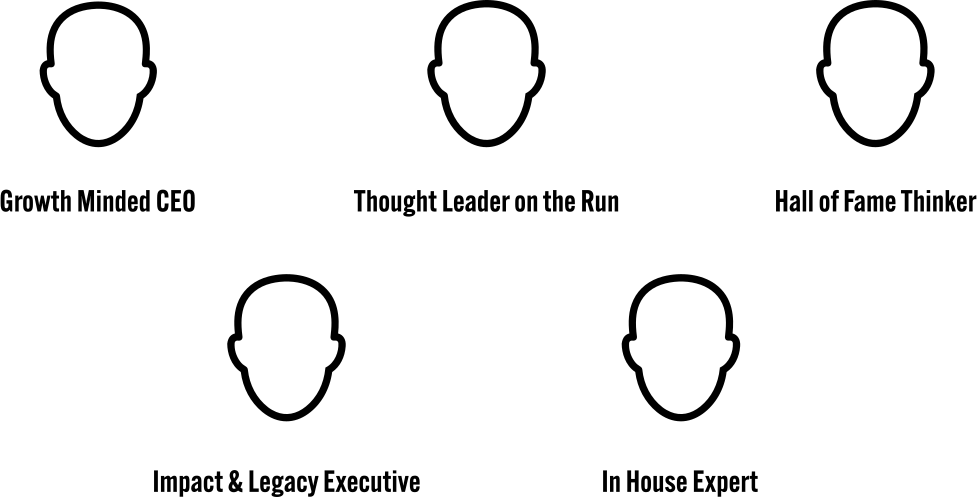
The Five Avatars of Thought Leadership — five archetypes for how leaders engage with thought leadership work

The Growth-Minded CEO

I practice thought leadership to help my core business grow.

What They Look Like

Current CXOs, founders, division presidents, and nonprofit heads

Their Why

Ideas become powerful strategic levers: opening doors that sales teams can’t, shifting buyer perceptions of a category, or defining a market before product launch.

Their Common Challenges

The Growth-Minded CEO has many demands on their time. Discretionary speech is rare, so it attracts attention. Their amplification tools belong to the executive role, and the role is temporary.

The Impact and Legacy Executive

I’m either on my way out of my current role or I have retired. But I’m not ready to ride off into the sunset.

What They Look Like

Typically outgoing executives, post-exit founders, and leaders moving from corporate life into boards, advisory work, or small-practice consulting.

Their Why

These former executives may seek continued relevance. They may want to share their knowledge with the next generation. Or they simply can’t stop thinking and moving.

Their Common Challenges

The institutional machinery that amplified their voice now answers to someone else. The Impact and Legacy Executive must learn to create impact with ideas, not their title.

The Thought Leader on the Run

I started studying a topic because I wanted to understand it better. Now people see me as an expert and will pay me for my insights.

What They Look Like

Typically independent experts, speakers, authors, and specialist consultants. In many cases their time is the product that’s for sale.

Their Why

The Thought Leader on the Run is an evangelist. They chaperone their ideas from room to room. That’s how they create impact for others and value for themselves.

Their Common Challenges

Their personal brand and their idea’s brand become so intertwined that separating them feels impossible. Their personal velocity is the asset and the ceiling.

The In-House Expert

I practice thought leadership on behalf of my organization.

What They Look Like

Typically senior employees, practice leaders, and subject-matter experts representing a company to the market.

Their Why

They serve as a credible voice on questions a marketing team can’t answer. Their organizations need the attention they can attract.

Their Common Challenges

They live between two audiences at once: the internal stakeholders they must stay on-message for, and the external audiences who want to hear what they actually think.

The Hall of Fame Thinker

I want my ideas to outlast me.

What They Look Like

Typically long-career thought leaders whose frameworks have entered the mainstream: books in MBA curricula, concepts that have entered the general business lexicon, ideas cited by people who no longer remember where they originated.

Their Why

Wants to step back from carrying every idea personally. It’s time to let others — protégés, students, licensees, and institutions — carry the work forward.

Their Common Challenges

The Hall of Fame Thinker and the idea have become a symbiotic pair; separation is the work.

How to Use the Five Avatars

Understand why you practice thought leadership. Sharpen the work through the Four Elements. Accelerate impact through the Impact Equation.

Notes

  1. Focusing on tactics (speaking, writing, consulting, coaching) is a surface level distinction. Any avatar can practice thought leadership through any tactic.
  2. People often shift between avatars during their careers — a Growth-Minded CEO who retires may become an Impact and Legacy Executive; a Thought Leader on the Run who takes a corporate role becomes an In-House Expert.

Buy The Thought Leadership Handbook (July 2026)