
Frequently Asked Questions
Answered by Bill Sherman, COO of Thought Leadership Leverage and lead author of The Thought Leadership Handbook.
What is thought leadership?
Thought leadership is the work of creating impact through the ideas you choose to advocate to a well-defined audience. Thought leaders reframe conversations, call attention to new topics, and change how people act, from individuals and teams to whole communities and societies. It’s different from content marketing, which exists to fill a sales funnel. Thought leadership gives valuable knowledge away, free or at low cost. Think of it as a brand for your ideas, the way you have a personal brand and your company has a corporate one.
How do I become a thought leader?
You become a thought leader when you choose to share your imperfect truths with an audience and serve it consistently. Thought leadership is a generous act: you give your insights to the people who can use them. It can also build you a good living and a business around your ideas. Not every expert makes that choice. Many stay silent, or keep what they know behind a paywall or inside their company.
Start with one core idea. Find an insight you care about enough to share not once but hundreds, even thousands, of times. Does it energize you? Does it serve a specific audience, not “anyone”? Does it sound like you? Polishing an insight into a core idea takes time. You’ll test it, watch how your audience responds, and adapt. Those are the first steps.
What’s the difference between thought leadership and personal branding?
Personal branding is about you: your reputation, your style, your skills. Thought leadership is a brand for your ideas. We call that your platform identity. Here’s a quick test. When you’re not in the room, how do people describe your work to someone else? If they describe you, your reputation and your style, more than your ideas, your personal brand is running ahead of your platform identity. That means your thought leadership still depends on you being in the room, or on the Zoom, to create value. Platform identity is one of the Four Elements of Thought Leadership.
Is thought leadership just self-promotion?
If your thought leadership is just self-promotion, it fails: audiences notice fast and stop trusting you. Done right, it serves the audience first. It can feel like self-promotion, even like sales. Here’s the honest check: am I advocating the idea, or promoting myself? See yourself as the steward of a core idea. Be a zealous advocate for it, serve your audience, and if they find it useful, they’ll seek you out.
Does thought leadership actually drive revenue?
Yes. In our study of 301 nonfiction authors, those whose primary goal was financial and had a clear strategy earned more than $100,000, twice as much as those without. That finding comes from A Comprehensive Study of Business Book ROI, which I co-authored with Josh Bernoff and Dr. AJ Marsden. Edelman’s Thought Leadership survey and Anderson and Marshall’s The ROI of Thought Leadership point the same way for corporate thought leadership.
Revenue isn’t the whole return. Thought leadership can give your work purpose and meaning. Many people practice it through their careers and keep going after they retire. It offers something rarer than income: the sense of a life well lived, and a legacy carried in your ideas.
Can AI replace thought leadership?
No. AI can flood the square with plausible noise, but the point of view that earns an audience’s trust still comes from a person. Experts with hard-earned truths face a choice: stay silent, live an exemplary life, or speak. I believe people who hold imperfect truths have a duty to speak them. They also have no right to an audience. They earn it.
AI is still useful in the work. It makes a sharp sparring partner, devil’s advocate, and research assistant, and it can take the pulse of a conversation. What it can’t do is see around the corner, tell signal from noise, or hand you a fresh insight. It predicts what’s expected. A new perspective is still yours to bring.
How can organizations practice thought leadership?
Organizations should treat thought leadership as a business function, not a side project. It needs a strategy, real resources, and people dedicated to planning, creating, and deploying the work. The Organizational Thought Leadership Canvas gives you a way to connect what the organization needs to achieve with what its audience actually needs. Its three columns and fifteen cells turn scattered effort into structured thought leadership a team can run.
What are the models, frameworks, and tools for thought leadership?
I built the frameworks I needed and couldn’t find. Eight of them, refined over twenty years of consulting. When I started in thought leadership, plenty of people practiced it and wrote books, but there were almost no models to help someone codify ideas and take them to scale. The eight:
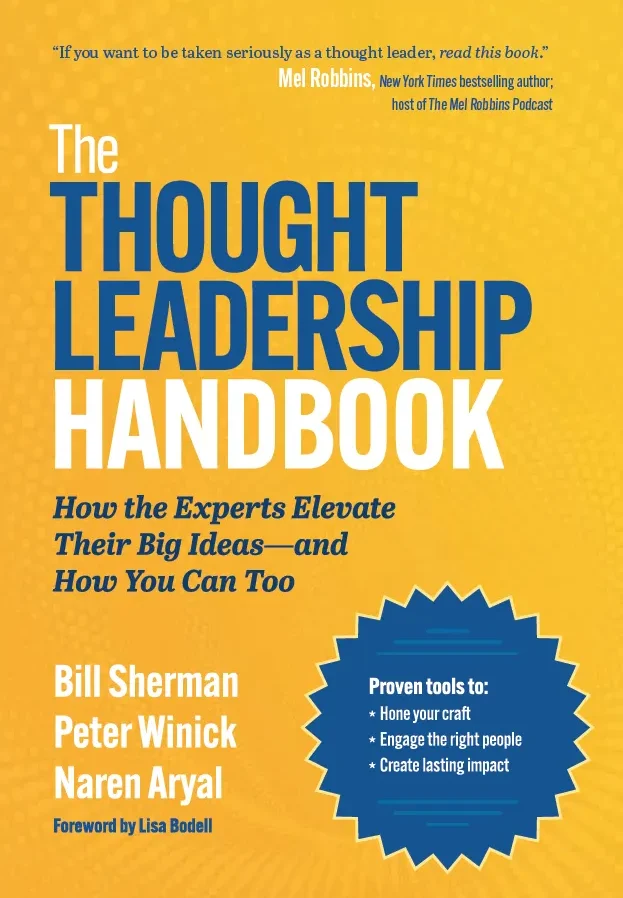
You’ll find all eight here on the site. I also placed seven of my frameworks in The Thought Leadership Handbook (by Bill Sherman, Peter Winick, and Naren Aryal).
Where can I learn more or go deeper?
For a long time, the only way to learn from me was to work with me. Now I’ve put the patterns, knowledge, and tools I use every day into the knowledge commons. So choose your own adventure:
- Want to hear other practitioners in their own voice? Listen to the Leveraging Thought Leadership podcast.
- Want to go deeper on the frameworks? Read them here on the site, or in The Thought Leadership Handbook.
- Looking for tools you can use? The book’s website has a section of them free to download.
- Want to talk? Follow me on LinkedIn or reach out directly. Maybe we can work together.