Skip to main contentSkip to footer

Organizational Thought Leadership Canvas

Organizations that build thought leadership practices ad hoc struggle. The investment shows up; the return doesn’t. They fund content before they define outcomes, chase audiences before they name a core idea, and measure vanity reach when the business case was supposed to justify the budget. Weak architecture wastes effort and limits impact.

The Organizational Thought Leadership Canvas was developed by Bill Sherman and published in a 2023 whitepaper co-authored with Peter Winick. It organizes organizational thought leadership into three columns: Your Organization, Targeted Audience, and The Bridge. Fifteen cells across the three columns must be built in sequence. The canvas is separate from individual-practitioner frameworks; it maps what happens when a company, not a person, commits infrastructure to ideas.
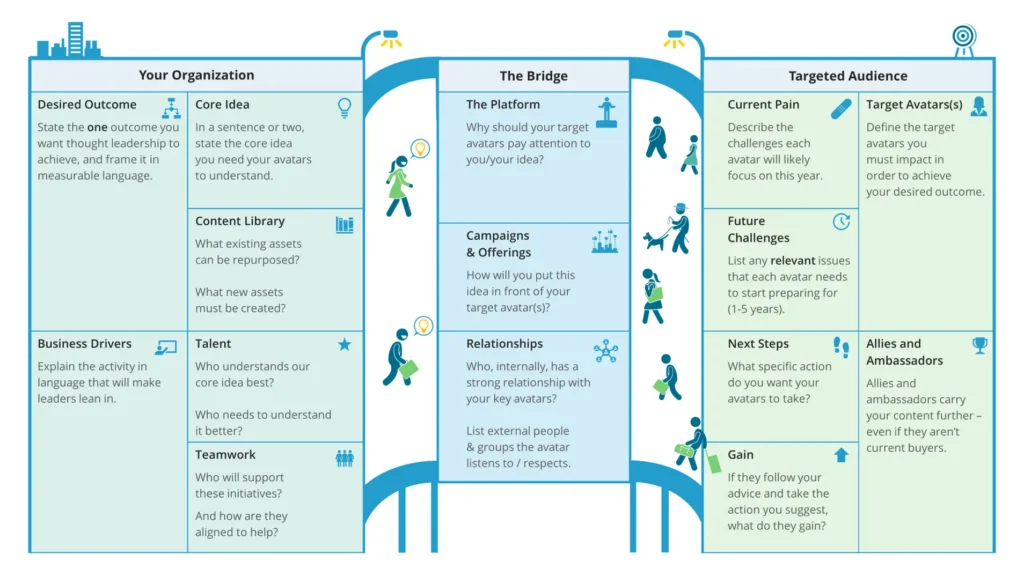

The Organizational Thought Leadership Canvas — planning tool for enterprise thought leadership programs

Your Organization

Your Organization is where organizational thought leadership earns its mandate.

What to Do Here

Six cells must be filled before a team writes a word (desired outcome, core idea, content library, business drivers, talent, teamwork). Skip any of them and the practice becomes content marketing with a thought leadership label. Desired outcome anchors the column. It names the business result the organization is buying with the investment.

Starts With

Your organization’s desired outcome.

Targeted Audience

Targeted Audience is where organizational thought leadership meets real demand.

What to Do Here

Six cells define who the organization serves and why they should care (current pain, future challenges, target audiences, next steps, allies and ambassadors, what they gain). Current pain anchors the column. It names the feeling that’s already there. In-house teams often invert this order, writing to the audience the organization aspires to serve rather than the one it actually reaches.

Starts With

Your target audience’s needs and wants.

The Bridge

The Bridge is where the organization and the audience connect, and it gets built last.

What to Do Here

Three cells carry the load (platform, campaigns and offerings, relationships). Platform names why the organization’s voice deserves the audience’s attention (the single sentence a target audience would use to describe the work to a peer). Campaigns and offerings name the vehicles, and Broadcasting, Narrowcasting, and Pointcasting live inside that cell. Relationships name who already carries trust with the target audiences. The bridge collapses when either bank is thin.

Starts With

Leveraging existing relationships and creating new ones.

Using the Canvas in Your Organization

Fill Your Organization before Targeted Audience. Fill Targeted Audience before The Bridge. Resist the instinct to lead with tactics. Campaigns without a bridge, bridges without a business case, and business cases without an audience are the three most common failure modes in organizational thought leadership practice. The canvas turns strategy into a checklist a team can execute without the founder in the room. Fifteen cells, three columns, one order.

Download the whitepaper at orgtl.com